Watch
Learn saju, one short at a time
Where the four pillars come from, how the five elements move, which animal you are, and how to read your own chart in the app.
Saju history
How a 3,000 year old calendar became a reading of character. About a minute each.
The calendar on the bone
About 3,000 years ago, diviners carved a calendar of sixty day names on a bone. Four names from that cycle are the eight characters of a saju chart.
Transcript
Look at this bone. It's about three thousand years old. Ancient Chinese diviners heated bones like this until they cracked, read the cracks as answers, and carved the question on the bone. But this one isn't asking anything. It's a calendar. Ten signs, the heavenly stems. Centuries later, read as five elements, yang and yin. Twelve more, the earthly branches. Later, the twelve animals. Pair one of each, and step both forward together. Ten and twelve only line up again after sixty steps. Sixty days, then the count starts over. Later, the same sixty named years, months and hours too. So every moment has four names. The four at your birth make eight characters. In Korea, reading those eight is called saju. Four pillars. So how did a calendar start describing people? That took two thousand years.
Oracle bone photo: Gary Lee Todd, CC0.
Five phases, not five elements
Wood, fire, earth, metal and water move in two cycles, one that feeds and one that checks, and a Chinese book tied them to the calendar over 2,000 years ago.
Transcript
Look at these five. Wood, fire, earth, metal and water. In English, the five elements. But the Chinese character, xing, means to move. So many scholars say five phases: stages of change, not stuff. In one cycle, each feeds the next. Old texts say how. Wood holds hidden fire. Fire burns to ash, which is earth. Earth's mountains grow metal. Metal melts and flows like water. Water makes wood grow. In the other, each checks one. Water puts out fire, fire melts metal, metal cuts wood, wood breaks earth, earth dams water. Two cycles. One feeds, one checks. Over 2,000 years ago, a Chinese book, the Huainanzi, tied them to the calendar. Each phase took two stems and two branches, but earth took four branches. Now every day carried an element. So did every birth. Count the eight characters of one afternoon. Four fire, three earth, one metal. No wood, no water. Every birth is a mix of five. That mix is what a saju reading weighs.
Saju in 15 seconds
One idea each: how the five elements feed and check one another, and where the twelve animals come from.
Wood feeds Fire
A tiny dragon cannot make fire until a tree drops it a dry branch. In saju, Fire never starts on its own.
Transcript
Look at this tiny dragon. All smoke. No fire. Then a tree helps out. One dry branch. Fwoosh! Oh. Wood feeds Fire.
Earth makes Metal
A gold medal, and the mother who drove her to practice at five every morning. In saju, gold always comes from somewhere.
Transcript
Look at this gold medal. Ten years of practice. But who drove her? Every morning. Five a.m. Worth it. Oh. Earth makes Metal.
Water feeds Wood
Sunflowers wilting since 1888 get a neighbor who has been pouring since 1658. In saju, nothing grows alone.
Transcript
Look at these sunflowers. Wilting since 1888. Luckily, a neighbor. Pouring since 1658. Ahh. Oh. Water feeds Wood.
Water calms Fire
The Scream gets a calm new neighbor on the gallery wall. In saju, every Fire needs a little Water.
Transcript
Look at these two. Same wall. Different days. So who's the calm one? Oh. Water calms Fire.
Fire softens Metal
A dad who will not smile on photo day, until his daughter gets to him. In saju, even the hardest Metal has a soft spot for Fire.
Transcript
Look at this dad. Photo day. Zero smiles. Who can crack him? Watch this. Click. Oh. Fire softens Metal.
Why the Rat comes first
The ox swims the whole race with the rat riding on his head, and the rat jumps first. The folk tale behind the order of the twelve animals.
Transcript
Look at this ox. First across wins the race. But who's on his head? Enjoying the free ride. And... jump! Oh. That's why the rat comes first.
Swipe through
Picture posts from our YouTube channel: find your animal, the element its year carries, and who it clicks with. Each one opens on YouTube.
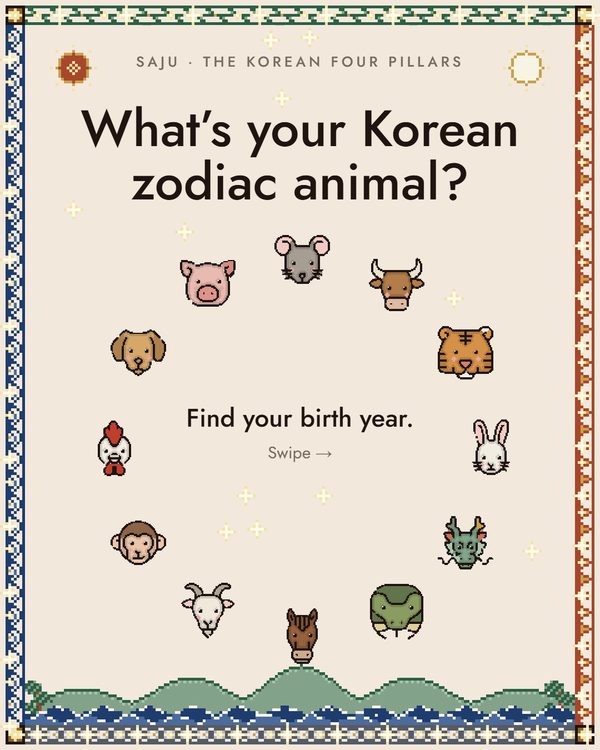
Which Korean zodiac animal are you?
All twelve animals and their birth years. Your birth year is just one of the eight characters in a saju chart.
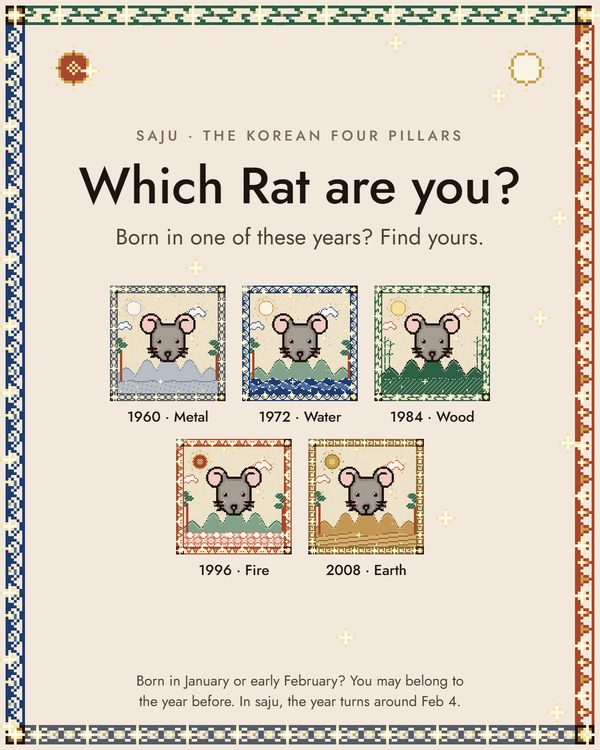
Which Rat are you?
Every Rat year also carries one of five elements. Find your year: Metal, Water, Wood, Fire or Earth.
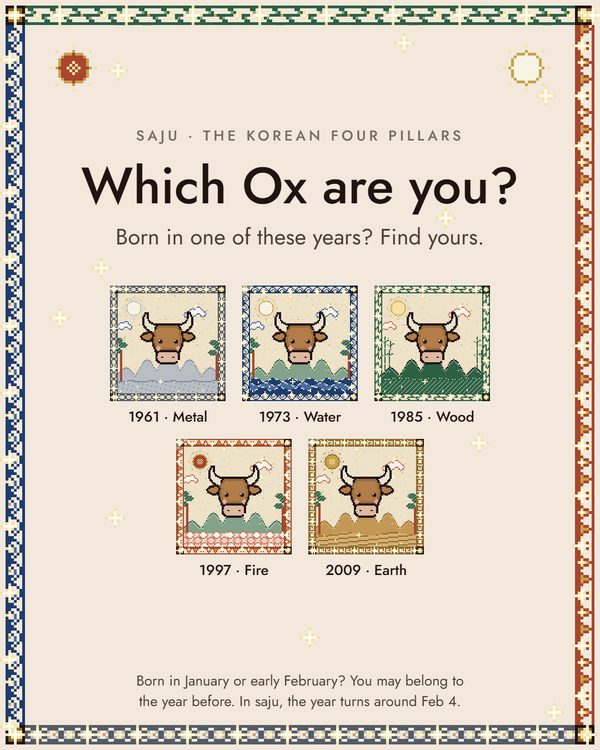
Which Ox are you?
Every Ox year also carries one of five elements. Find your year: Metal, Water, Wood, Fire or Earth.
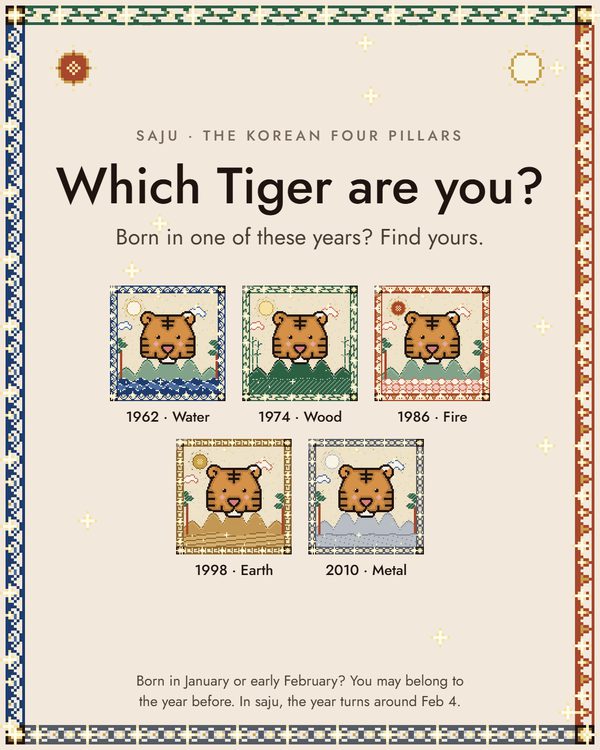
Which Tiger are you?
Every Tiger year also carries one of five elements. Find your year: Metal, Water, Wood, Fire or Earth.
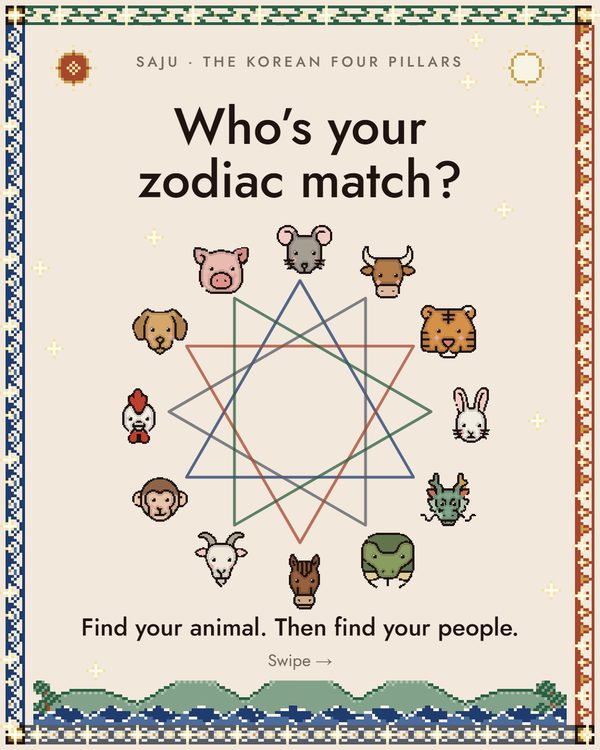
Who's your zodiac match?
The four trios that share an element, the six pairs that click quietly and the six across the wheel that pull hard.
How to use InnateGlyph
Recorded in the real app, one screen at a time.
Find your glyph
Sign in, enter your birthday and flip your card: your glyph is one of 450. It works without a birth time.
Transcript
Wait, your birthday has a shape? Let's find yours. Sign in. Enter your birthday. No birth time? Tap No idea. It still works. Hit Begin. Flip your card. That's your glyph, one of 450. Explore yourself through Saju, a Korean tradition. And that's just the beginning. Download free. Go find yours. Visit InnateGlyph.com.
Your chart, one section at a time
Glyph, Traits, Fuel, Harmony, your four pillars and your mix of the five elements: what each part of My Chart shows.
Transcript
Okay, let's get to know your chart! This is My Chart. Let's go one by one. Glyph: your card in four parts. Tap one to see what it means. Traits: how you show up in love, work, money, and more. Fuel: what charges you up, and what drains you. Harmony: the glyphs you click with, and the ones that clash. These are the four pillars of Saju. Elements: your mix of wood, fire, earth, metal, and water. Get to know yourself. Download free! Visit InnateGlyph.com!
Universe
Your chart stays the same while the energy around you changes: daily, monthly, yearly and by decade.
Transcript
Okay, now let's check your Universe! Your chart stays the same. The energy around you keeps changing. Daily: how today's energy meets yours. Tap a day to peek ahead. Monthly: your year, month by month. Tap one to see its vibe. Yearly: what each year of your life leans toward. Decade: the big ten-year chapters of your life. Know your timing. Download free! Visit InnateGlyph.com!
Orbit
A hundred years of one life, one dot a day, with noble stars where help tends to come from others. Orbit comes with Plus, and free users can explore a sample life.
Transcript
Last up, Orbit! Tap Chart, then Orbit. A hundred years of your life, one dot a day. Drag to turn it. Days that feel alike sit close together. Zoom in, then step day by day with the arrows. Open a day to read it: love, money, work, and more. See the stars? Those are your noble stars! Tap one to see when help tends to come from others. Orbit comes with Plus. Free users can explore a sample life first. See your whole life. Download free! Visit InnateGlyph.com!
Match
Add a friend by QR code, friend code or birthday, then read your pair: the score, and how your energies lean together.
Transcript
Now, Match! Open the menu, then Match. Let's add a friend. Tap Friends, then Add. Send them your QR code or friend code, or just add their birthday. Type a name and a birthday, then Add person. Now tap to read your pair! Your score, and how your energies lean together. Switch tabs, and the score changes for love, work, and family. Scroll down to see where you click. Find your people. Download free! Visit InnateGlyph.com!
New videos go up on YouTube first.
@InnateGlyph on YouTube