My Chart · Library
How matches are scored
Two different calculations sit behind the people you see. Type harmony on My Chart compares your chart with a glyph, which is a pattern and has no pillars. A pair reading on the Match screen compares two real charts, animal signs and all. They are different arithmetic, and the difference is the first thing below.
For the sections these numbers appear in, see people & matches.
Watch
Match
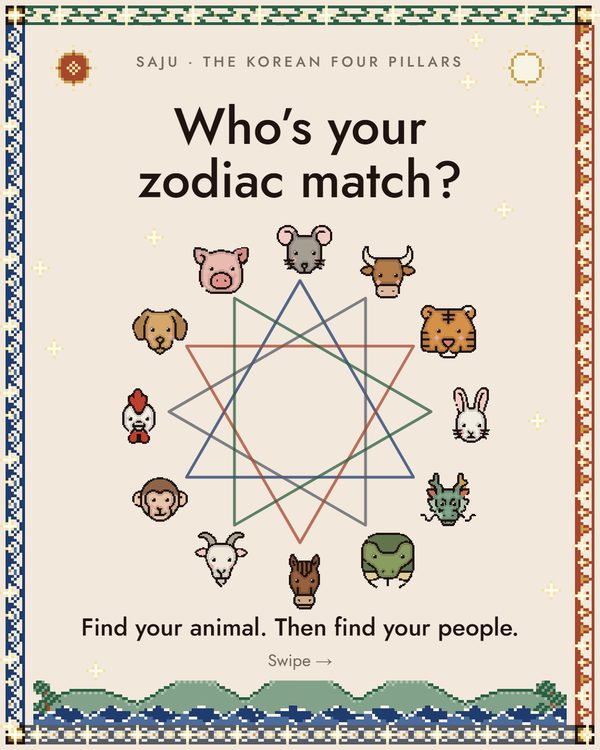
Who's your zodiac match?
How we calculate type harmony
- Your chart is compared with each glyph on the four things a glyph has. They are how your day element and its element meet, how the two strengths sit together, drive against drive, and rhythm against rhythm. Then one more: whether that glyph's element is on your helpful or your caution list. No AI does the ranking.
- Animal branches are not in this one. A glyph is an element, a strength, a drive, and a rhythm. It has no pillars, so there are no animals to clash or combine. That is the difference from a real pair reading on the Match screen, which does read them.
- Each context is scored on its own, because romance and work weigh things differently.
- The best and worst fits are shown so you can scan them quickly. They are not a verdict about specific people.
How a pair reading is scored
This is the other calculation, the one behind a pair reading on the Match screen, where two real charts meet. Unlike type harmony above, it reads branches, so clashes and combinations between the two sets of pillars count.
Five things are compared, and each finding they produce carries a direction and a confidence:
- Core chemistry: how the two day elements meet.
- Everyday dynamics: how the animals of the two charts meet, pillar by pillar. This includes the resentment pairs (wonjin), a staple of Korean folk matching: six animal pairs read as a low irritation that is hard to name. It comes from a folk table, not from the structure of the chart, so it is the lightest mark the reading gives.
- Element support: whether your helpful and caution lists overlap or cut across each other, and whether one chart actually holds what the other is missing. See below.
- Drive fit: whether the two charts want similar things.
- Pace & rhythm: whether one leans active where the other leans quiet. It is shown but does not change the score.
Each finding counts +1 if it leans supportive, −1 if it leans effortful. That is multiplied by how confident it is: 3 for high, 2 for medium, 1 for low. Add those up, multiply by four, and add fifty. That is the score. It is why fifty means “nothing pulling either way”, not “average”.
The “How the score adds up” panel on the reading is that same arithmetic, one bar for each part. It is a receipt, not a second opinion.
When one of you has what the other lacks
Traditional practice treats this as the heart of a pairing. It is why two people with very different charts can steady each other.
Your helpful elements are what your chart is short of. Roughly one person in eight has none at all of an element their own chart says would settle them. That counts the stems hidden inside each animal as well as the eight characters you can see. So the reading asks a second question about elements: does the other chart actually carry it? When one of you has none of something and the other has a lot, that counts toward the score.
The same question runs the other way. If one chart is heavy in an element the other already finds effortful, that counts against. Both can be true in the same pairing: someone can fill a real gap for you and bring a lot of what tires you, at once.
Mutual counts for more than one-way. Two charts filling each other's gaps is a different pairing from one person doing all the filling, and the reading says which it is. It does not say who. The calculation is the same from either side on purpose, so a pair never gets two different answers depending on who opened it.
Why Love and Work give different numbers
The five tabs do not run five separate readings. They score the same findings with different weights, because what matters between two people depends on what they are to each other.
- Overall weights everything equally: it is the plain, unweighted score.
- Love leans hardest on the day branches, the pillar traditionally read for a partner, and on the day elements.
- Work leans on drive and element support, and gives less weight to how the animals meet.
- Family leans on the year and month branches, the layers read for home and upbringing.
- Friends leans on the day elements and drive, and cares least about the year and month branches.
So a pair can be steadier at work than in romance from the very same findings. Switching tabs re-weights the bars as well as the number. That lets you see which part the difference came from.